

How to Dominate NHL Trivia: A Hockey Fan's Guide to Guessing Games
Design a custom hockey puck: learn materials, artwork prep, and simple steps to order for your team, event, or brand.
Ever found yourself stumped trying to name that third-line grinder who had one good season with the Flames back in '09? If you live for the thrill of NHL trivia and love putting your hockey knowledge to the test in games like NHLdle, you've come to the right place. This is your playbook for turning those near-misses into top-shelf snipes.
Your Ultimate Playbook for Hockey Guessing Games
Winning at hockey guessing games is about more than just knowing Connor McDavid's stats. It’s about remembering the journeymen, the one-hit wonders, and the subtle clues that separate the casual fan from the true hockey historian. We're talking about the kind of deep knowledge you'd share with a buddy at the rink between periods.
From minor hockey heroes who got a cup of coffee in the show to draft-day steals, a well-rounded knowledge base is your ticket to victory. Think of this guide as your power play for making smarter guesses and climbing those leaderboards. We’ll break down the strategies that will give you the inside edge.
This infographic breaks down the simple flow from a player clue to a correct guess.
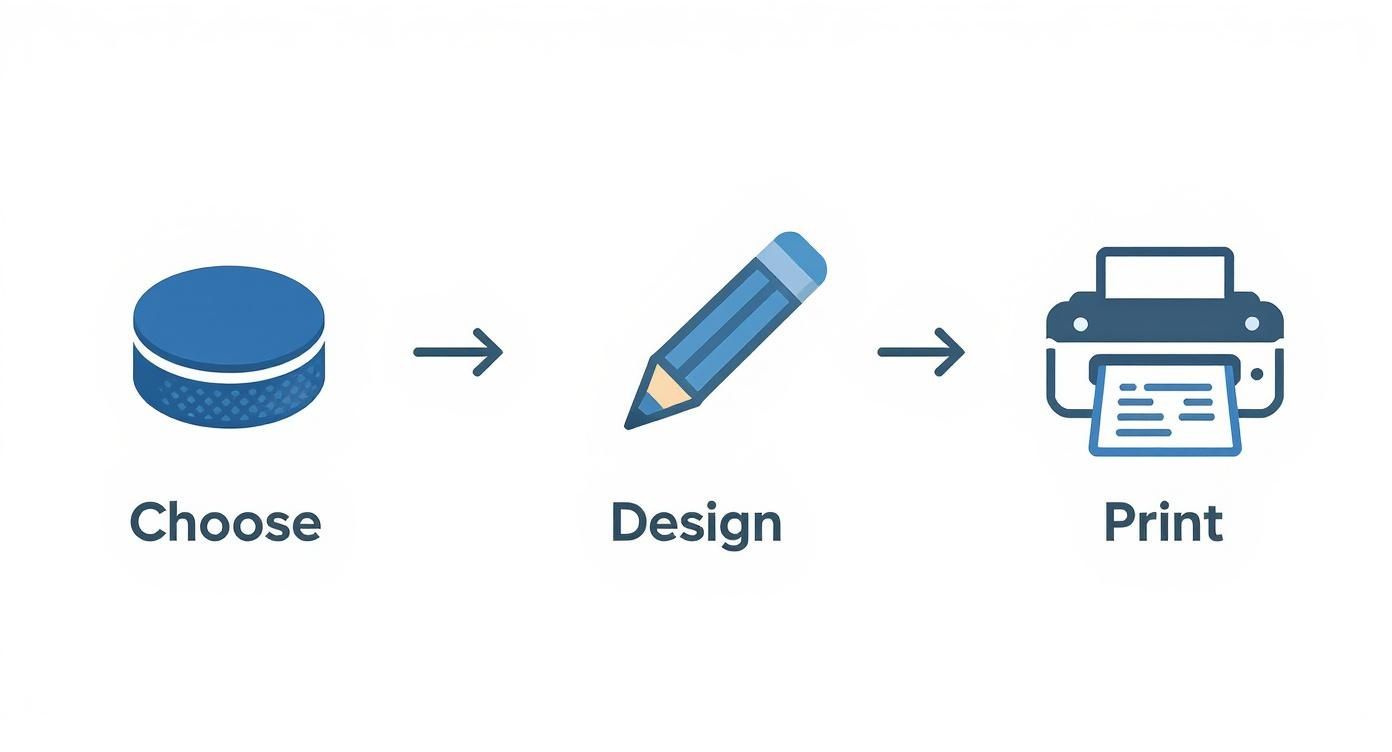
As you can see, the journey from a puzzle to a perfect score boils down to three core phases: analyzing clues, narrowing the pool, and making an educated guess. We're about to dive deep into all of them.
Why Mastering Trivia Makes You a Better Fan
Think about the most impressive hockey fans you know. They can recall not just the big moments, but the small details that make the sport's history so rich. Mastering hockey trivia does exactly that. It connects you to the game on a deeper level, celebrating players from every era:
- Legendary Goalies: From Terry Sawchuk to "The Dominator," knowing goalie careers is key.
- Franchise-Defining Players: Think Joe Sakic with the Avs or Steve Yzerman with the Wings.
- One-Team Wonders: Players who spent their entire, memorable careers with one club.
A great trivia guess is like a perfect celly—it’s memorable, shows off your hockey smarts, and gets you fired up. It’s a small detail that makes a huge difference.
If you’re the type of fan who loves diving into the nitty-gritty of the game, from player stats to team history, you'll appreciate the thought that goes into these games. It’s that same passion that drives fans to test their knowledge with fun daily challenges. This guide brings that same level of detail to the table to help you absolutely nail your next guess.
Alright, let's get this done. Understanding the player pool is the first, and honestly, most crucial step in the whole process. Get this wrong, and the rest doesn't matter much.
Choosing the Right Player Pool for Your Guess
So, you're faced with a silhouette or a set of stats. Awesome. But before we even think about specific names, we have to answer one simple question: what era is this player from?
Seriously, that's the big decider. It's the difference between guessing a modern-day power forward and a gritty stay-at-home defenseman from the 80s. One is built for today's high-speed game, the other was built for the old Adams Division battles.
Modern Stars vs. Old-School Legends
Think of it this way: modern players are your current warriors. They’re the guys you watch every night – a mix of speed, skill, and specialized roles. These are the players defined by advanced stats, highlight-reel goals, and their presence on social media. If the stats show high shot totals and power-play points, you're likely in the post-lockout era.
Then you have old-school legends. These are the show ponies of hockey history. They played in a different game, often with different rules and team strategies. Their stats might look wildly different—think goalies with 10 ties in a season or defensemen with 100+ penalty minutes. Just don't let their stats fool you; these guys were absolute beasts.
Here's the bottom line: your clues determine the era. For stats showing lots of power-play goals and few penalty minutes, you're in the modern era. For clues involving defunct teams like the Hartford Whalers or high penalty totals, you're digging into hockey history.
The Canadian Difference in Player Types
When it comes to player development, where they’re from is a huge deal. Canadian players, especially from the CHL, often have a certain style. They've been scouted and developed for everyone from the pros to the local Junior A leagues.
Take a classic Canadian power forward, for instance. That player is a beast, specifically built to win puck battles in the corners. It’s no wonder they are a staple on any successful team. It’s also wild to see how much things have changed; recent data shows that over 60% of all-time NHL players are Canadian-born. It’s all about that hockey DNA, right from the start. You can really see the difference in puck manufacturing standards just like you can see the difference in player styles from different countries.
Here's a quick cheat sheet to help you narrow it down:
- High-Scoring Defenseman: Don't even think about it. Start with names like Bobby Orr, Paul Coffey, and Cale Makar. You need that game-breaking talent.
- Goon with a Scoring Touch: Souvenir-grade guess? No, this is a real player type. Think Tie Domi or Bob Probert, guys who could drop the gloves and pot a few goals.
- Elite Two-Way Center: This one's a toss-up. It could be a modern Selke winner like Patrice Bergeron or a classic leader like Ron Francis. The clues about their draft year will be your guide.
Nailing Your Guess with Key Details
This is where the magic happens. Your analysis is what transforms a simple set of clues into a legendary correct answer for your daily game. Getting the details just right is the difference between a guess that is close and one that is absolutely perfect.
Think of your analysis like a perfectly executed dangle—it needs to be clean, sharp, and precise. A wild, unsupported guess is the on-ice equivalent of catching an edge on a breakaway. It just kills the whole play. To avoid that disaster, the single most important thing is to use all the clues.
Jersey numbers, draft positions (Adobe Illustrator can't help you here!), and player height/weight are your best friends. They are built with hard data, which means your guess can be narrowed down without losing a shred of accuracy. It’ll stay perfectly crisp. Try to guess based on points alone, and you’ll end up with a long list of possibilities.
Getting the Teams Right
A player's team history is the heart and soul of their identity. You wouldn't want to forget that Daniel Alfredsson was Mr. Senator, right? To make sure your guesses are spot-on, you need to understand the player's career path.
- Franchise Player: This is the guy who played most, if not all, of his career with one team. Think Mario Lemieux with the Pens.
- Journeyman: This is the language of the trade deadline. It’s how a player like Jaromir Jagr ends up playing for nine different NHL teams.
Your game probably shows you a player's team for a given season. Always cross-reference that with their draft year and age. It’s a small step that makes a massive difference, ensuring the final guess matches all the available data.
Think of the clues as your starting lineup. If you ignore a key piece of information (like the player's position or the conference they played in), you’re setting yourself up for a tough game. A clean analysis using every clue is like sending your top line over the boards—you know you're going to get a quality result.
Trivia Must-Knows for a Perfect Guess
Guessing a player from a list of thousands is one thing; using subtle clues is a whole different game. You have to account for the unique data points to make sure your guess isn't just a shot in the dark. It's all about playing within the lines.
You'll see two key types of clues: static and comparative. A static clue is a fact, like "Drafted in 2005." This is your anchor. A comparative clue is "Older than Sidney Crosby." This helps you place the player in context.
Seriously, when the game gives you a clue, use it! It’s your playbook for a perfect guess every single time.
To wrap it up, here's a quick checklist to run through before you lock in your guess. Getting these details right from the get-go will save you a ton of wasted attempts and get you to the right answer that much faster.
Guessing Checklist:
- Position: Have you filtered your mental list by Forward, Defenseman, or Goalie?
- Era: Have you used the draft year and age to place the player in the right decade?
- Team History: Does the player's career path match the team clues provided?
- Nationality: Did you pay attention to the player's home country? This can eliminate hundreds of names instantly.
- Stats Profile: Is the player a scorer, a grinder, or a defensive specialist? Match the stats to the player type.
Nailing these five points is your hat trick for flawless guessing.
Getting from Clues to a Correct Answer: Common Strategies
Alright, you've analyzed the clues and picked a player pool. Now for the magic moment: making the guess. This is where your hockey knowledge becomes a real weapon, and the strategy you choose is a huge deal—it affects your speed, your accuracy, and how well you'll score.
Think of it like choosing your stick flex. There's a right tool for every job. Let's walk through the top three guessing methods so you can pick the winner for your puzzle.
The Anchor Guess: A Reliable Workhorse
The anchor guess is the seasoned veteran of the group. It's a straightforward process where you pick a well-known player from the same era to get a baseline. For a puzzle from the early 2000s, guessing a name like Joe Thornton gives you immediate feedback on age, draft year, and stats.
If you're facing a tough puzzle and the player isn't obvious, an anchor guess is your go-to. It’s hands-down the most effective route for getting valuable information early on.
The Process of Elimination: The Power Play
Next up is elimination—this is your power forward. It works by using a strong clue, like nationality or position, to immediately slash the number of potential players, resulting in a guess that’s not only smarter but also more likely to be right.
That targeted approach means you can avoid wasting guesses on players who don't fit. This is my top recommendation for puzzles where one clue stands out, like a player from a less common hockey country or a goalie. It helps you zero in on the right answer like a champ.
The Obscure Knowledge Snipe: The Modern Superstar
The obscure knowledge snipe is the flashy, high-skill superstar on the team. Think of it as the Connor McDavid of trivia guesses. It uses deep-cut hockey knowledge to identify a player from a subtle clue that most people would miss. Maybe you remember a specific trade, a one-year captain, or a player who wore an odd jersey number.
This is the only choice for solving puzzles that seem impossible at first glance. NHL trivia has absolutely exploded in popularity, and a big reason is that it rewards fans who have invested time in learning the game's history. This strategy opens the door to amazing "Aha!" moments and separates the great players from the good ones.
Expert Tip: Your puzzle's clues should guide your choice. For puzzles with a clear era but an unknown player, use an anchor guess. But for a jaw-dropping quick solve, nothing touches the brilliance of an obscure knowledge snipe.
Getting a handle on the technical differences between eras, like the trade-offs between the dead puck era and today's game (digital vs. offset printing methods have nothing on this), can give you a deeper appreciation for how player stats change over time.
Dialing in the Final Guess
Last but not least, let's talk about the final check. It’s a subtle touch, but it can completely change the outcome of your game.
- Sanity Check: Does the player's name feel right for the team and era? A quick mental check can prevent a silly mistake.
- Spelling Check: A typo can turn a right answer into a wrong one. Make sure you've spelled that tricky European name correctly.
Honestly, this choice comes down to carefulness and the process you've developed. A quick double-check can make a bold guess stick the landing.
Getting Your Timing and Strategy Right
Okay, let's get down to the nitty-gritty. Your first guess is in, you have some green and yellow boxes, and now it's time to talk logistics. How do you get from a partial match to the correct answer without a last-minute panic? It all comes down to planning your next few guesses.
First up, you’ll encounter the 8-Guess Limit. Every game has one. Why? Because it forces you to make educated guesses—calibrating based on feedback and getting the clues just right. It simply doesn't make sense to allow unlimited guesses. Most games give you eight attempts, but this can feel tight for really tricky players.
Breaking Down the Clues
Here’s where you can really play it smart: the more clues you get right, the smaller the player pool becomes. It's a classic process of elimination. Getting the Team, Position, and Age correct, for instance, will slash the number of possibilities compared to just knowing the conference.
This is a massive advantage for players planning their guesses, trying to solve in the fewest attempts, or anyone looking to get more bang for their buck. You end up with a high-quality, satisfying solve for a price that’s much easier on the ego. My advice? Always focus on the most restrictive clue first. You might be surprised to find that knowing a player's exact age is the key that unlocks the whole puzzle.
Planning your NHLdle guesses is like setting up a power play. You need to know your options, anticipate the next clue, and execute with a clear goal in mind to avoid getting caught flat-footed.
Turnaround Times and Daily Streaks
Whatever you do, don't wait until 11:55 PM to start the daily game! Time pressure is a huge piece of this puzzle. A standard solve might take a couple of minutes, and that's before you factor in any tough clues. If you're really in a bind, most games offer hints, but be prepared to take a hit to your pride for that speed.
The good news is that online games and speedy websites have made hockey trivia more accessible than ever. A local fan, for example, can now play a daily game against thousands of others in no time. If you want to see how this works in action, you can explore how Canadian suppliers handle rapid fulfillment for physical products, which is a whole different kind of speed.
To give you a rough idea, here's a typical guessing timeline:
- First Guess: 10-15 seconds. This is your best bet for establishing a baseline.
- Mid-Game Guesses: 3-7 clues. This will cost you some attempts, but it's a lifesaver when you're on a tough puzzle.
- Final Guess: Within 8 attempts, depending on where you are in the process and the strategy you choose.
Always, always build in a buffer. Rushed guesses can pop up when you least expect them, and the last thing you want is for your streak to end. A little planning upfront makes all the difference.
Alright, the puzzle is solved and your awesome score has been posted. The excitement is real. So, what's next? This is where the real fun begins. A well-played game is so much more than a score—it's a perfect way to prove your hockey knowledge, whether you're playing against friends or just yourself.
For hockey teams, the possibilities are practically endless. Sure, you can just play for bragging rights, but let's think bigger. Imagine having a team-wide league, with a prize for the monthly champion. It blows a generic team chat out of the water and becomes a competition they'll actually get into. It also makes for a killer way to engage with fans and sponsors who pour their hearts into the team.
Thinking Outside the Rink
Don't let the daily puzzle be the limit! In the corporate world, these games are an absolute power play. Picture yourself on a team-building call, surrounded by a sea of awkward icebreakers. When you launch a competitive hockey trivia game, you're not just passing time—you’re making a connection. Hosting a company charity drive? A trivia competition is a touch that says you mean business.
If you want to get your head around how these fit into a wider marketing plan, this guide on promotional products has some seriously smart ideas on engagement.
Even personal events can get a major upgrade. We’ve seen die-hard hockey fans use trivia as an unforgettable part of a pre-game party or fantasy draft. They’re also a fantastic way to pass the time during intermission, creating a tangible connection to the sport you love.
The best use for hockey trivia is one that tells a story. Whether it’s celebrating a championship team or remembering an obscure player, it turns a simple game into a meaningful connection.
Want to really take it to the next level? Think about the preparation. A small, dedicated notebook for tracking tough players or a group chat for discussing the daily puzzle can instantly transform your game from a cool pastime into a serious hobby. Even something as simple as watching classic game highlights adds to your knowledge base.
For a fun team-building twist, why not create a custom trivia game about your own company's history? You could even fire up our random NHL player generator to get some inspiration for a quiz night where bragging rights are the grand prize. Now that’s a hat trick.
Got Questions About Hockey Trivia? We've Got Answers
Alright, let's go top cheese on a few common questions that pop up when you're gearing up to play daily hockey trivia. Getting these details sorted out first means you'll be ready to make your first guess with confidence.
Can I Guess a Player Who Isn't in the Database?
This is a big one we get all the time. The short answer is almost always no, as the games pull from a specific, pre-loaded list of players.
Official NHL trivia games use a set database, often including anyone who has played at least one game. Reputable games won't accept names that aren't on their list. Your best play is to stick with players you know have played in the NHL, especially in the modern era, unless the clues point to an older player.
How Important Is Draft Position, Really?
Draft position really boils down to two things: the era the player was drafted in and what you plan to do with that information.
If you're trying to identify a superstar, a top-5 draft pick is a huge clue. But for a journeyman player, it can be misleading. A guy drafted in the 7th round who carves out a 10-year career is just as valid as a 1st round bust.
On the other hand, if you're trying to distinguish between two similar players, knowing one was a high pick and one was a low pick can be the tiebreaker you need to get the answer.
What’s a Typical Starting Guess?
A great starting guess definitely varies between players, but a common strategy for a hockey guessing game is to use a well-known player from the last 10-15 years.
This "anchor" guess isn't meant to be correct, but it gives you a ton of information right away. It's always a good idea to have a go-to first guess, as it can help you get oriented quickly, especially for tougher puzzles.
Knowing these details is like having the right strategy for the NHLdle daily guessing game—it sets you up for a confident win.
Ready to test your hockey knowledge while waiting for your pucks? Play the original hockey guessing game at SportsDle and see if you can solve today's mystery player! https://www.sportsdle.com
Article created using Outrank