

Unleash Your Inner Hockey Guru: The Ultimate Guide to NHL Pucks
Explore hockey pucks nhl: specs, history, and how to spot a genuine game-used puck in this complete fan guide.
You know that little black disc that flies around the ice at over 100 mph? There's a whole lot more to an official NHL hockey puck than meets the eye. It's not just a chunk of rubber; it's a piece of high-performance equipment, fine-tuned for the fastest game on Earth.
To keep the game consistent and fair, every single puck used in an NHL game has to meet a strict set of standards. This ensures that every clapper, every saucer pass, and every deflection behaves exactly as the best players in the world expect it to.
What Makes an NHL Puck Official?
So, what really separates the pucks you see the pros snipe from the ones you might find at a local sporting goods store? It all comes down to a precise recipe and a design that's been perfected over decades.
The official NHL puck specs were largely established way back in 1940 by the legendary Art Ross and have remained remarkably consistent. Each puck must be exactly 1 inch (2.5 cm) thick and 3 inches (7.6 cm) in diameter. Its weight has to fall within a tight range: 5.5 to 6 ounces (156-170 grams).
These pucks are made from a special blend of vulcanized rubber mixed with other bonding materials. This isn't just any rubber—it's engineered to be incredibly durable and to have just the right amount of bounce (or lack thereof, as you'll see).
Why Do They Freeze Hockey Pucks?
Here's a great piece of hockey trivia that's perfect for stumping your buddies: official game pucks are always frozen before they hit the ice. The off-ice officials keep a stash of them in a small freezer, chilled to about 14°F (-10°C), and they're swapped out regularly during play.
But why? A warmer, room-temperature puck is actually bouncier. When it hits a stick, the boards, or a goalpost, it tends to flutter and jump around. Freezing the puck makes the rubber harder and kills that bounce.
This cool little trick is a game-changer:
- Less Bouncing: A frozen puck stays flat, gliding smoothly across the ice instead of bouncing like a superball. This gives players way more control for dangles and passes.
- Faster Glide: A harder, flatter puck has less friction with the ice, so it moves faster and more predictably.
- Keeps Players Safer: When pucks stay on the ice, they're less likely to fly up and hit a player in an unprotected area.
The next time you see the ref skate over to the penalty box for a fresh puck, you'll know he's getting one straight from the cooler. It’s a simple step that makes the game faster, safer, and more skillful.
That Textured Edge Has a Purpose
If you ever get your hands on an official game puck, run your finger along the edge. You'll feel a distinct, bumpy pattern. This is called a knurled or diamond-crosshatched edge, and it’s there for a very important reason: grip.
That texture helps the puck "stick" to the tape on a player's blade for a split second longer. This allows players to generate more spin and control when they pass or shoot. When a superstar sniper fires a wrister that goes top cheese, that knurled edge is helping them get the rotation they need for pinpoint accuracy.
For more deep dives into the gear and science that make hockey great, check out our other hockey insights.
Official vs. Other Pucks: What's the Difference?
It’s easy to get confused with all the different pucks out there. You’ve got your official game pucks, then training pucks, and of course, the souvenir ones you might catch at a game. They might look similar at a glance, but they're built for completely different jobs.
Here’s a quick breakdown to help you tell them apart.
Official NHL Puck Specifications vs. Other Pucks
| Specification | Official NHL Game Puck | Training Puck (e.g., Weighted) | Souvenir/Replica Puck |
|---|---|---|---|
| Weight | 5.5 - 6 oz (156-170 g) | Varies (e.g., 10 oz for strength) | Usually lighter, around 4-5 oz |
| Material | Vulcanized rubber blend | Often heavier rubber or steel-infused | Softer, less dense rubber |
| Edge | Knurled (diamond pattern) for grip | Can be knurled or smooth | Typically smooth or less defined |
| Hardness | Very hard, designed to be frozen | Varies by training purpose | Softer, not meant for high impact |
| Primary Use | Professional games and elite play | Skill development (stickhandling, shooting) | Collectibles, autographs, keepsakes |
An official puck is a finely-tuned instrument. While a weighted training puck is fantastic for building wrist strength and a souvenir puck looks great on a shelf, only the official version is built to withstand the force of a 100 mph slapshot while gliding perfectly flat.
The Puck's Journey: From Factory to Faceoff
Ever stop to think about where that little black disc of vulcanized rubber actually comes from? The story of an official NHL hockey puck is a fascinating tale of precision craftsmanship, and it all starts long before the puck ever hits the ice. In fact, pretty much every single official puck begins its life in Quebec.
This isn't some sterile, fully automated assembly line. It's a hands-on process that perfectly blends science with old-school skill. It all kicks off with a special mix of natural rubber, antioxidants, and bonding materials. This concoction is then shaped into cylindrical "pre-forms," which look a lot like oversized, uncooked cookies.
From Raw Rubber to a Perfect Disc
The transformation from a soft pre-form to a rock-solid puck happens under some serious heat and pressure. Each one is placed into a two-piece compression mould that gets cranked up to over 300°F (150°C). Then, the mould clamps down with incredible force, simultaneously shaping the rubber into a perfect disc and vulcanizing it.
After a quick cure, the pucks pop out and are set aside to cool. But they aren't quite ready for the big leagues just yet. Each puck has a little bit of extra rubber around the edge, known as "flash," that needs to be trimmed off. Skilled workers trim this flash by hand, making sure every puck has a perfectly smooth and uniform edge.
This infographic shows you just how precise those final measurements have to be.
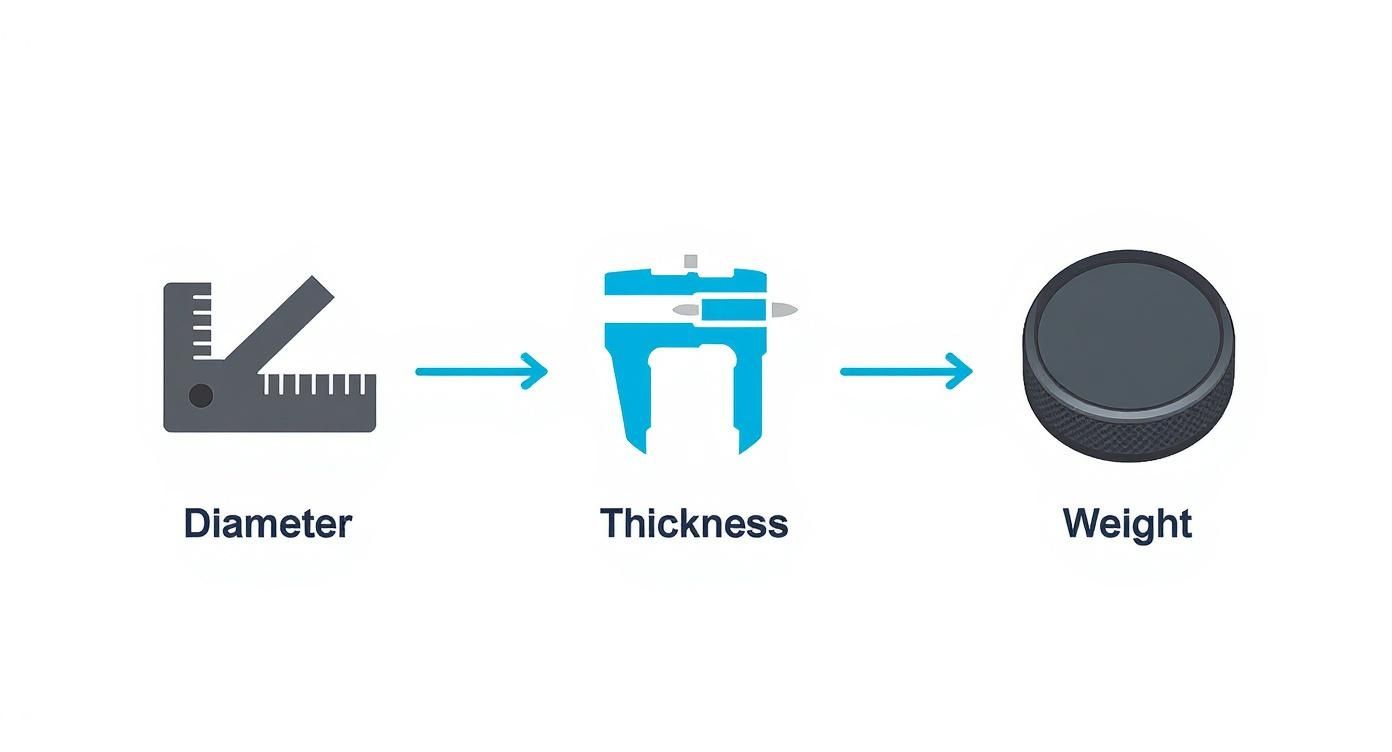
Those specs for diameter, thickness, and weight are completely non-negotiable. This strict standard ensures every puck flies, slides, and bounces the exact same way, no matter which arena it's in.
The final touch is the branding. Team and league logos are silk-screened on, with each individual colour baked on separately. This meticulous process guarantees the logos can take a beating from sticks, skates, and goalposts without chipping away.
From a simple lump of raw materials to a finished product ready for a McDavid clapper, the creation of an official NHL puck takes just a few minutes. But it's the precision packed into those few minutes that allows it to perform at the highest level.
Supplying the Greatest League on Earth
The demand for these little black discs is absolutely staggering. The NHL burns through an incredible number of hockey pucks nhl officials count on for every single game. We're talking about 180,000 pucks each season, with Canadian manufacturers like Sher-Wood leading the production charge. A single supplier provides roughly 6,000 pucks per team, per year, to cover games, practices, and special events.
If you want to see the factory in action, you can watch the full story of how these pucks are made.
The Final Steps Before Puck Drop
Once the pucks leave the factory, their journey still isn't over. They're shipped out to all 32 NHL arenas, where they're handed over to the off-ice officials. Here’s a peek at the game-day ritual:
- Selection: A specific batch of pucks is chosen for the game.
- Freezing: They’re popped into a freezer for several hours. This gets them to the ideal temperature, which is key to reducing bounce on the ice.
- Rotation: A frozen puck is only at its best for a few minutes before it starts to warm up. Officials are constantly swapping them out during stoppages to make sure a fresh, frozen puck is always in play.
It’s not uncommon for a dozen pucks to be used in a single period, especially during a chippy, physical game with tons of shots flying off the glass. From a factory floor in Quebec to the referee's hand at centre ice, it's a carefully controlled journey that protects the integrity of the fastest game on ice.
How to Spot a Genuine Game-Used Puck
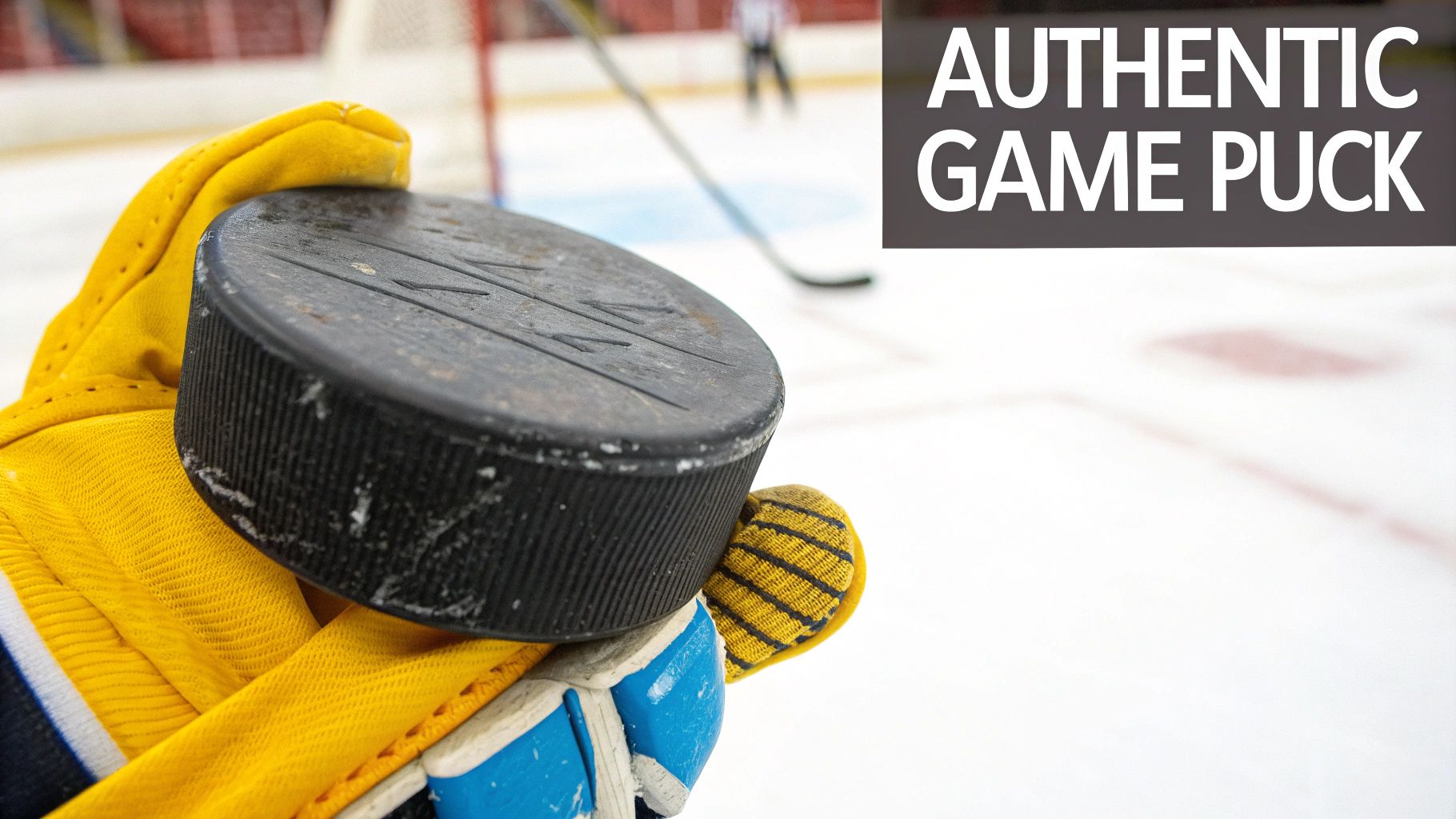
For any real hockey nut, getting your hands on a game-used puck is like holding a piece of history. This isn't just some souvenir you grab at the team store; it's a chunk of vulcanized rubber that has been absolutely hammered by sticks, blocked by skates, and maybe even ricocheted off a goalie's helmet in an NHL barn.
But with so many fakes floating around, how can you be sure your prized puck is the real deal? Spotting a legit game-used puck comes down to knowing the signs of authentic game action. It’s all in the gritty wear and tear you simply can't fake.
Look for Signs of Authentic Wear
A puck that’s actually seen NHL ice time will tell a story. It won’t look clean. What you want to see are the marks that prove it was right in the middle of the battle. These are the tell-tale signs that a puck has been through the wringer.
- Stick Marks: Keep an eye out for white or coloured paint transfers from stick blades. You’ll often see smudges and streaks where the puck was passed, shot, or stick-handled.
- Board Burns: When a puck smacks the boards at full speed, the friction creates these flat, shiny spots on the rubber. These "board burns" are an amazing sign of authenticity.
- Skate Nicks: A puck that's been caught up in a scrum in front of the net will almost always have little nicks and cuts from razor-sharp skate blades.
- Post Dings: This is the holy grail! A puck that rings off the iron will have a very distinct, curved dent on its edge. Finding one of these is like finding gold.
A brand-new, mint-condition puck is perfect for getting an autograph, but a genuine game-used one should look like it’s been in a war. Those scuffs, marks, and dings are its badges of honour.
The Official Stamp of Approval
Beyond the physical evidence, the absolute best way to know a puck is legit is through official authentication. The NHL has programs in place specifically to give collectors peace of mind.
If you buy a puck directly from the arena or an official team retailer, it often comes with a Certificate of Authenticity (COA). But the gold standard is the NHL Authentication Program, which uses a tamper-proof hologram sticker with a unique serial number.
You can punch that number into the official NHL database to see exactly which game the puck was used in, and sometimes even which period! This system ties your puck to a specific moment in hockey history, which is as good as it gets for a collector.
Feel the Difference
Never underestimate what you can tell just by touch. An official game puck has a unique feel that replicas almost never get right. One of the biggest giveaways is that knurled, diamond-patterned edge we talked about earlier.
Run your thumb along the edge of the puck. It should feel coarse and incredibly grippy. That texture is there to give players better control, and it's a manufacturing detail that counterfeit pucks often mess up. If the edge feels too smooth, you should be skeptical.
Protecting your investment is everything. For some broader tips, this collector's guide on how to spot fake antiques has some fantastic universal strategies for telling a real treasure from a clever forgery.
Knowing these details won't just help you build a killer collection; it deepens your appreciation for the game. Plus, it makes you a beast at hockey trivia. If you love putting that knowledge to the test, you’ve got to try our NHL Roster Mystery game, where every little clue counts.
Diving Into the NHL Puck Collector's Market
To a true hockey fanatic, a puck is way more than just a piece of equipment. It’s a frozen moment in time, a tangible slice of the game's epic history. This is what makes collecting the hockey pucks NHL fans go wild for so special—every single one has a story.
The value of a game-used puck has nothing to do with the rubber it's made from; it’s all about the story attached to it. Was this the puck that went bar-down for a player’s 500th career goal? Maybe it was the one blocked in the frantic final seconds of a Game 7 Stanley Cup Final? Moments like these transform a simple disc into a treasured piece of memorabilia.
What Makes a Puck a True Collectible?
So, what separates a run-of-the-mill souvenir puck from a collector's holy grail? It all boils down to one thing: significance. A puck from a random Tuesday night game in November is cool, but one from a milestone event? That’s in another league entirely.
Here's a look at what collectors are always hunting for:
- Milestone Pucks: Think a player's first NHL goal, a goalie's landmark shutout, or the puck used to shatter a team record. These are tied to unforgettable achievements.
- Playoff & Finals Pucks: Pucks from the Stanley Cup Playoffs, especially the Final, are always in high demand. A puck from the game-winning goal that clinched the Cup is a legendary artifact.
- Player Association: A puck handled by a superstar carries incredible value. Imagine owning the puck Sidney Crosby used to snipe an OT winner or one Connor McDavid dangled with on a highlight-reel goal.
- Special Event Pucks: The NHL rolls out unique pucks for events like the Winter Classic, Stadium Series, and All-Star Games. Their limited runs and killer designs make them instant fan favorites.
The Story is Everything
A puck that just happens to fly into the stands is a fantastic souvenir. But a puck that was part of a memorable play? That’s where the real magic—and value—kicks in. For die-hard collectors, the ultimate dream is owning a piece of a story they can tell for life.
Think about the difference here. A puck from an Auston Matthews hat-trick game is one thing. But owning the actual puck from his third goal of that night? That’s a whole different level. It’s the physical evidence of a legendary performance.
The more significant the moment, the more valuable the puck becomes. It's not just about owning an object; it's about owning a piece of a legacy, a fragment of hockey lore that you can actually hold in your hand.
Getting a Feel for the Collector's Market
The market for these items is a massive and passionate part of hockey culture. While the global ice hockey puck market itself was valued at around USD 0.72 billion, the collector's side is driven purely by fan passion. North America, especially Canada, is the undeniable heart of this market, with a deep-rooted love for the game's history. You can get more insights on the global puck market on businessresearchinsights.com.
Building a great collection is almost like a guessing game—you need to know your history and be able to spot a valuable player. If you love that challenge, test your knowledge with our random NHL player generator and see if you can recall the stats of legends and hidden gems alike.
How to Care For and Display Your Puck Collection

So, you’ve finally got your hands on a fantastic puck! Maybe your favorite player flipped it over the glass, or you scored a game-used gem from a legendary matchup. Awesome! But now what? Keeping that little piece of hockey history looking its best is every bit as crucial as getting it in the first place.
When it comes to handling your prized pucks, the golden rule is simple: less is more. For signed pucks, always try to hold them by the edges. The natural oils on your skin can break down the ink over time, turning a crisp silver autograph into a faded memory. This goes for game-used pucks too—handling by the edges helps preserve all those cool battle scars.
Choosing the Right Display Case
Letting a special puck roll around loose on a bookshelf is just asking for trouble. A solid display case isn't just a fancy box; it's a shield that protects your investment from dust, dings, and the ultimate villain of collectibles: sunlight.
When you're shopping for a case, there’s one feature that’s an absolute must-have: UV protection. Seriously, don't even consider a case without it. Ultraviolet rays will fade team logos and signatures faster than a slapshot. A quality UV-protected case is your best defense.
Once your collection starts to grow, figuring out how to show it off is half the fun. You can pick up some great universal tips for displaying your collection like a pro that work just as well for pucks.
Ideal Storage and Cleaning Conditions
Where you keep your pucks is just as important as what you keep them in. The perfect spot is a room with a consistent temperature and humidity. That means attics, basements, and garages are out—the extreme temperature swings can do real damage. And, it goes without saying, keep them far away from direct sunlight.
Cleaning is a breeze if you do it right. A quick, gentle wipe with a soft, dry microfibre cloth is all you need to get rid of dust. Never, ever use chemical cleaners! They can strip the finish, ruin logos, and completely destroy a signature.
Pro Tip: Got more than a few pucks? Try organizing them by team, a specific player, or a memorable event. A thoughtfully arranged display doesn't just look amazing; it tells a fantastic story about your love for the game.
To help you get started, here’s a look at some of the most popular ways to display pucks.
Puck Display and Storage Options
| Display Method | Pros | Cons | Best For |
|---|---|---|---|
| Individual Cube Case | Fantastic protection, they're stackable, and totally affordable. | A large collection can start to look a bit cluttered. | Making a single, high-value puck the star of the show. |
| Wall-Mounted Frame | Shows off a bunch of pucks in one clean display; great space-saver. | Can get pricey; pucks don't have individual protection. | Creating that jaw-dropping "puck wall" feature. |
| Open Shelf or Stand | Super easy access to your pucks and very inexpensive. | Offers no protection at all from dust, UV rays, or accidental damage. | Souvenir or replica pucks that aren't rare or valuable. |
No matter which route you go, following these simple steps will ensure your pieces of hockey pucks nhl history stay in mint condition. They'll be the pride of your fan cave for years to come.
Your Top NHL Puck Questions, Answered
Every fan has wondered about the little black disk at the heart of the game. Let's dive into the details—the kind of insider knowledge that'll make you sound like a pro during the next intermission or help you crush your daily NHLdle challenge.
We've pulled together the most common questions from fans, collectors, and curious minds to give you the real story.
Why Do They Freeze Pucks Before a Game?
This is one of the coolest pieces of hockey trivia. Pucks are kept chilled to about -10°C (14°F) for a simple reason: a warm puck is a bouncy puck. Nobody wants that.
Freezing the vulcanized rubber makes it significantly harder and denser, which kills its natural bounce. This little bit of science is what keeps the puck gliding flat and true on the ice instead of skipping around. It means better puck control for the players and a faster game for us to watch.
How Many Pucks Does a Single NHL Game Go Through?
You might be surprised by just how many pucks an NHL team uses in one night. A typical game burns through around 12 to 15 pucks. The off-ice officials have a freezer full of them right by the bench, ready for action.
A puck gets taken out of play for a few reasons: it starts to warm up, it gets launched over the glass, or it gets nicked up by skates or a hard ring off the post. In a high-energy game, officials toss in a fresh, frozen puck at almost every whistle.
What Happens to a Puck That Flies Into the Crowd?
Catching a puck that sails over the glass is a legendary fan experience. If one comes your way, it's all yours! It’s a classic case of finders keepers, and you walk away with an incredible (and free!) souvenir.
These pucks are amazing mementos, but they aren't officially authenticated game-used collectibles unless you go through the proper channels. Still, you're holding a piece of rubber that was literally in the middle of NHL action just seconds before. How cool is that?
A puck flying over the glass is a fantastic souvenir, but a puck from a historic moment is a true treasure. The difference in value is all about the story—a random game puck is a cool memory, while a puck from a record-breaking goal is a piece of NHL history.
What's the Rarest or Most Valuable Kind of Puck?
For hockey pucks NHL collectors chase after, value is all about the story it tells. A standard puck from any old game might not be worth much, but one tied to a massive moment? That can be priceless.
The holy grails of puck collecting are almost always milestone pucks. We're talking about the puck a superstar used to score their 500th career goal, a rookie's first-ever NHL goal, or the one that wins the Stanley Cup in overtime. These are the artifacts of hockey lore, and they become legends in their own right.
Think you've got your puck knowledge down? It's time to prove it! At SportsDle, we’ve built the ultimate hockey guessing games to challenge even the most die-hard fans. Whether it's our Classic player-guessing game or the tricky Roster Mystery, it’s the perfect way to test your hockey IQ. Play for free and see if you can climb the leaderboard.