Master the Stanley Cup Playoffs Bracket Challenge
Dominate your Stanley Cup Playoffs Bracket Challenge! Get expert tips on picking winners, choosing scoring systems, and running your hockey pool.
The Stanley Cup Playoffs are pure magic, and there's no better way to dial up the intensity than with a bracket challenge. It's the ultimate test of hockey smarts, gut feelings, and a little bit of luck.
So, you're thinking of running a pool with your friends, family, or the folks at the rink? Fantastic. You've come to the right place.
Your Ultimate Playbook for the Bracket Challenge
Welcome to the best two months in hockey! The Stanley Cup Playoffs are a war of attrition—a gauntlet of grit, skill, and sheer will that crowns the toughest team in sports. For fans like us, a Stanley Cup Playoffs bracket challenge is the perfect way to get in on every second of the action.
Think of this guide as your complete playbook for total bracket domination. Whether you're the commissioner setting up the office pool or just desperate to finally shut down your loudmouth buddy, we’ve got your back. We'll walk through everything from setting up the pool and picking a scoring system to sharing some insider tips for making smarter picks.
This isn't about throwing darts at a wall. It’s about blending your hockey IQ with a bit of strategy to make every goal, save, and series-clinching celly that much more electrifying.
Why the Bracket Challenge Is a Playoff Tradition
The bracket challenge has become a cherished part of the NHL postseason for one simple reason: it hooks you into the game on a whole other level. Suddenly, you have a rooting interest in every single series, even those that don't feature your beloved team. That late-night tilt between two Western Conference teams? It might just be the one that decides your pool.
This tradition is practically baked into the DNA of Canadian hockey fans. Participation in these online contests has absolutely exploded, with thousands throwing their predictions into the ring each year. In 2023, the official NHL Bracket Challenge saw over 1.2 million brackets submitted globally, with a whopping 35% estimated to have come from Canadian fans.
It’s this shared experience that builds an incredible sense of community. The group chat blows up with trash talk after a big upset, and everyone instinctively gathers around the TV for a Game 7, their brackets hanging in the balance. It's more than just a game; it's a shared ritual that makes the greatest tournament in sports even better.
Key Takeaway: A well-run bracket challenge ramps up the playoff experience for everyone. It sparks friendly competition, gets people invested in every series, and gives every fan a personal stake in the outcome—from the opening puck drop to the final handshake line.
Getting Your Challenge Started
Before you start agonizing over a potential Leafs vs. Bolts matchup, you need a game plan. Nailing down a few key details right from the start ensures your challenge runs smoothly and everyone is on the same page.
To help you get organized, here’s a quick rundown of the essential components you need to launch a killer playoff pool.
Bracket Challenge Quick Start Guide
| Component | Key Decision |
|---|---|
| Bracket Template | Find a clean, printable bracket that's easy for everyone to fill out and share. |
| Clear Rules | How do people submit picks? What’s the deadline? How will scores be updated? |
| Scoring System | Will you use a standard model or get creative with bonus points for upsets? |
| Tiebreaker | Decide on a simple tiebreaker, like predicting the total goals in the Final series. |
Locking in these elements from the get-go prevents any confusion down the road. It lets everyone focus on what really matters: crafting that legendary, championship-winning bracket.
Now, let's get ready to prove you’re the true playoff guru.
How To Set Up Your Playoff Pool
Alright, let's get your Stanley Cup Playoffs bracket challenge set up and ready for action. The secret to a legendary pool isn't just about nailing the champ; it’s about a rock-solid, easy-to-understand setup that gets everyone hyped from the get-go. A bit of planning now saves you a world of headaches later when someone’s wild-card pick goes on an unbelievable run.
First thing's first: you need the bracket. The foundation of the whole pool! As soon as the playoff matchups are set, you'll find tons of great, printable templates online from all the major sports sites. Just find a clean one you like, download it, and have it ready to fire off to your group.
Laying Down the Law
With your bracket in hand, it's time to set a few ground rules. This isn't about being a tyrant commissioner; it's about making sure the pool is fair, fun, and crystal clear for everyone involved. Think of it as setting the rules of engagement before the opening face-off.
The absolute most important rule is the deadline. Make it firm. No exceptions. The best way to do it is to set the submission deadline for one hour before the puck drops on the very first game of the playoffs. This kills any chance of someone gaining an edge after watching the first period unfold.
Next, figure out how everyone will get their brackets to you. Keep it simple! My go-to method is having everyone email a clear photo or a scanned PDF of their masterpiece. This creates a digital paper trail with a timestamp, so there's never a debate about who sent what or when.
Choosing a Scoring System
This is where you can really put your stamp on the pool. The scoring system is the engine that drives the whole competition and directly impacts how people fill out their brackets. Your mission is to pick a system that keeps things interesting and competitive right down to the final handshake line.
There are a few tried-and-true models to think about:
- Classic Escalating Points: This is the fan favourite for a reason. Points for a correct pick increase each round, putting a huge emphasis on correctly predicting the Stanley Cup winner. A classic structure might be 10 points for Round 1, 20 for Round 2, 40 for the Conference Finals, and a massive 80 for the champ.
- Upset Bonus Points: If your crew loves a good underdog story, this is a must. Toss in some bonus points for correctly picking a lower-seeded team to win a series. It adds a delicious layer of chaos and keeps people invested even if their top seeds get bounced early.
- Series Length Bonus: Want to reward the true hockey prophets in the group? Award a small bonus, say 3-5 points, for correctly guessing the exact number of games in a series—but only if they also picked the correct winner.
Pro Tip: Whatever you do, don't overcomplicate it. The best scoring systems are the ones that are a breeze to understand and track. A simple round-by-round point increase paired with a solid tiebreaker is usually all you need for an amazing pool.
If you really want to dive deep into postseason predictions, you can find inspiration all over, even by looking at how the pros approach the AHL playoffs. For a different flavour, check out our guide on the Calder Cup Playoff bracket.
The All-Important Tiebreaker
Trust me, it happens more than you'd think. After two months of gut-wrenching, overtime hockey, you can easily have a couple of people tied for the top spot. A clear, pre-determined tiebreaker is absolutely essential to crown one undisputed champion and avoid any awkwardness.
The most popular and, in my opinion, the most effective tiebreaker is predicting the total number of goals scored in the entire Stanley Cup Final series. It's a fantastic stat because it's impossible to know beforehand and requires a smart guess based on the two teams' playing styles.
Looking for other creative options? You could also use:
- Predicting the Conn Smythe Trophy winner (MVP of the playoffs).
- Guessing the exact number of games played in the Final series.
- The closest prediction for total power-play goals scored in the Final.
Just pick one and make sure everyone knows what it is when you send out the rules. With your bracket, rules, scoring, and tiebreaker locked in, your pool is officially ready for puck drop.
Choosing Your Scoring System and Tiebreakers
Alright, this is where the fun really begins. The engine of any great Stanley Cup Playoffs bracket challenge is a solid, well-thought-out scoring system. As the commissioner, you get to decide what kind of challenge this will be. Are we rewarding the person who saw the final matchup from a mile away, or are we celebrating the beautiful chaos of a Cinderella run?
How you set up your points will directly shape everyone's strategy. A good system keeps the competition tight and the trash talk flowing, making sure everyone is glued to the games right until the very end.
This handy little visual breaks down the core pieces of putting your hockey pool together—from the bracket itself to the all-important tiebreaker.
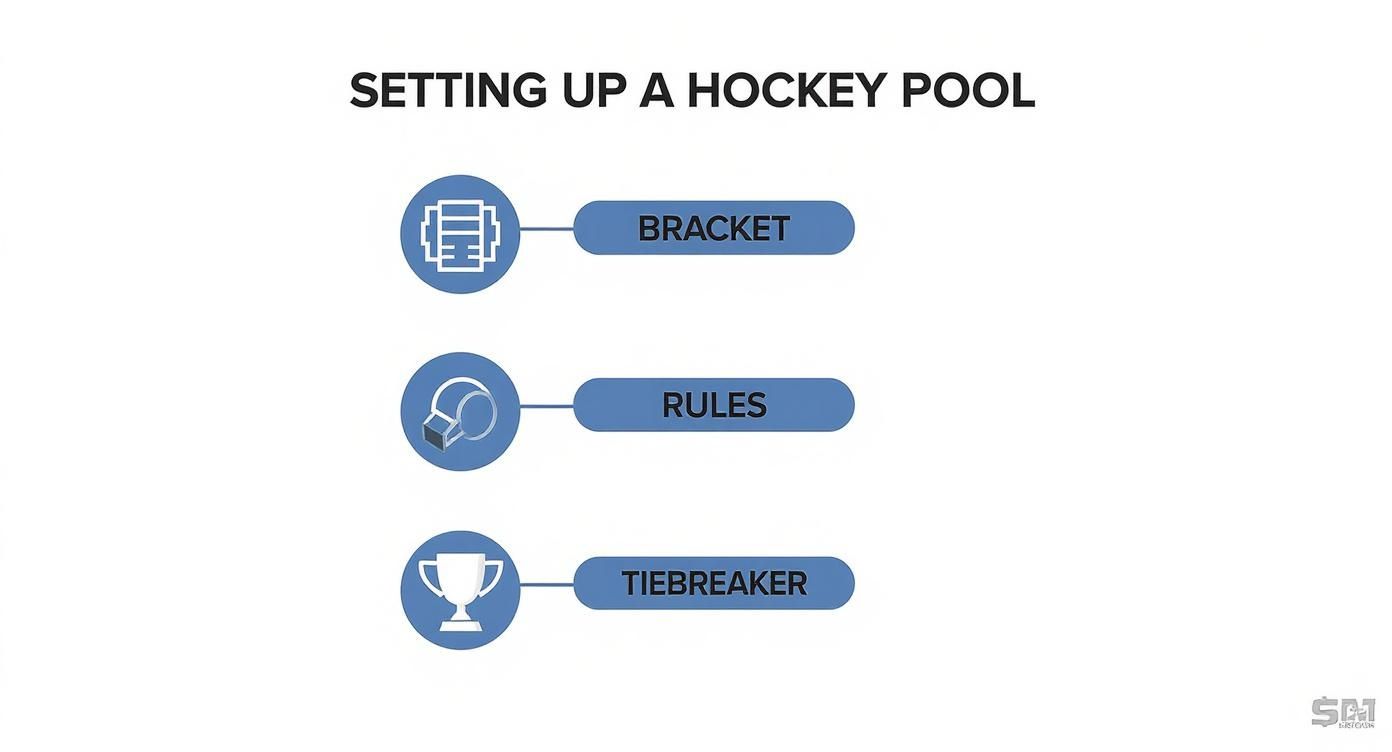
As you can see, a killer challenge boils down to three simple pillars: a clean bracket, fair rules, and a tiebreaker that leaves no room for debate. Let's dive into the details of the last two.
Popular Scoring Models
Look, you don't need to reinvent the wheel here. The most common approach for a reason is the Standard Escalating Points model. It's simple, it's effective, and it puts a huge emphasis on correctly picking the Stanley Cup champion. This setup is all about rewarding the long-term vision over a few lucky first-round guesses.
A classic breakdown looks something like this:
- Round 1: 10 points per correct series winner
- Round 2: 20 points per correct series winner
- Conference Finals: 40 points per correct series winner
- Stanley Cup Final: A whopping 80 points for nailing the champ
This structure is brilliant because it means someone who has a disastrous first round can still storm back if they correctly predicted the final two teams. It keeps hope alive, and that's absolutely crucial for keeping people engaged.
To help you figure out what's best for your group, here’s a quick comparison of the most popular ways to set up scoring.
Popular Scoring System Comparison
| Scoring Model | Best For | Pros | Cons |
|---|---|---|---|
| Standard Escalating | Most pools, especially with a mix of casual and serious fans. | Easy to understand; heavily rewards picking the champion; keeps people in it until the end. | Can feel a bit "chalky" if favourites dominate; a bad Final pick is devastating. |
| Flat Points Per Round | Simplicity and rewarding round-by-round accuracy. | Every series in a round is worth the same; rewards people who nail the early rounds. | The Final carries the same weight as Round 1, which can feel anticlimactic. |
| Seed-Based Bonuses | Groups that love chaos and underdog stories. | Adds major excitement for upsets; rewards bold, knowledgeable picks. | Can be complex to track; might overly reward a lucky guess on a huge upset. |
| Series Length Bonus | Die-hard hockey nerds who want an extra layer of skill. | Separates the true gurus; adds another fun element to track during each series. | Adds complexity; can feel like a "bad beat" if a series ends unexpectedly. |
Ultimately, the best system is the one that fits the vibe of your group. Don't be afraid to mix and match to create the perfect blend of strategy and fun.
Adding Some Spice with Bonus Points
If your group lives for the chaos and goes nuts for a good underdog story, you absolutely have to throw in some bonus points. This is where you can get creative and make your pool stand out from the crowd. It's also a great way to stop one person from running away with the whole thing after the first week.
Give the Upset Bonus a try. Awarding extra points—say, 5 or 10—for correctly picking a lower-seeded team to knock off a favourite is a game-changer. This simple twist encourages bold predictions and celebrates the glorious unpredictability that makes the playoffs the best post-season in sports.
Another fantastic option is a Series Length Bonus. Offer a small handful of points (maybe 3-5) for correctly predicting the exact number of games in a series. This is what separates the real hockey gurus from the casual pickers, as it forces a deeper level of thinking.
Key Insight: Don't be afraid to mix and match! In my experience, the most exciting challenges combine a standard escalating system with an upset bonus. It perfectly balances rewarding sound long-term predictions with those savvy, gutsy underdog picks.
Crafting the Perfect Tiebreaker
Trust me on this one: even after two months of gruelling hockey, ties at the top of the leaderboard happen way more often than you'd think. A clear, definitive tiebreaker is non-negotiable if you want to crown one undisputed champion. It’s the final, critical piece of your setup puzzle.
The gold standard here is asking everyone to predict the total number of goals scored in the Stanley Cup Final. It’s the perfect tiebreaker—a pure guess that's still grounded in real hockey knowledge. Will it be a tight, defensive grind between two goalies standing on their heads, or a high-flying, top-cheese snipe show?
If you want to try something a little different, here are a few other excellent options that test your group’s hockey smarts in fun ways:
- Predicting the Conn Smythe Trophy winner (playoff MVP)
- Guessing the total number of overtime games throughout the entire playoffs
- Naming the player who will score the Stanley Cup-clinching goal
Whatever you land on, make sure it’s spelled out in the rules before a single bracket is submitted. This heads off any arguments down the road and guarantees a smooth, fun finish to your challenge.
Strategies for Filling Out a Winning Bracket
Alright, let's talk strategy. Crafting a legendary bracket for your Stanley Cup Playoffs bracket challenge is a true art form. It's time to graduate from just blindly picking your favourite team and start thinking like a seasoned hockey analyst. A brilliant bracket is the perfect cocktail of hockey smarts, key stats, and that gut feeling you only get from watching the game all season long.
Ready to build a bracket that can actually go the distance? The first place to look is always between the pipes.
Goaltending Wins Championships
It’s the oldest cliché in hockey for one simple reason: it's true. A hot goalie can absolutely steal a series. They can single-handedly shut down a high-flying offence and carry an entire team on their back. Before you even think about pencilling in a team for the next round, you have to look at who’s in the crease.
How has the starting netminder played down the stretch? Is he seeing the puck like a beach ball, or has he been letting in some questionable goals? Your best friends here are stats like save percentage (SV%) and goals-against average (GAA). A goalie rockin' a .920 SV% or better heading into the playoffs is a guy you can count on when the pressure is immense.
Special Teams and That Sweet, Sweet Momentum
Next up, zoom in on special teams. Playoff hockey is notoriously tight-checking, which means a single power-play goal can be the difference-maker in a game—and ultimately, a series. A team with a power play that’s absolutely lethal, clicking at over 25%, can be a serious bracket-buster.
On the flip side, a lockdown penalty kill is just as crucial. The teams that can consistently snuff out the other guy's man advantage are the ones built for the gruelling playoff grind.
And don’t you dare ignore which teams finished the regular season on an absolute tear. A club riding a five-game winning streak into the postseason is brimming with confidence and playing its best hockey at the perfect time. Momentum is a very real, very powerful force in this league.
Digging Deeper Than the Standings
While picking the big upsets is what makes these challenges so much fun, you have to remember that the top seeds are favourites for a reason. They’ve proven their mettle over an 82-game season. But to find those hidden gems and potential bracket-busting upsets, you need to look past the standings.
Here are a few deeper factors to chew on:
- Key Injuries: Is a team’s top goal-scorer or number-one defenceman nursing an injury? Even if they're playing, a nagging issue can be a massive X-factor that slows a team right down.
- Head-to-Head Records: Tread carefully with this one. While it’s interesting to see how teams matched up during the regular season, the playoffs are a completely different animal. That regular-season dominance can sometimes be fool's gold.
- Player Performance: Are the stars showing up? You need your best players to be your best players. It's worth it to check out detailed NHL player stats and see who's lighting the lamp and who might be in a slump.
When you're piecing together your master plan, leaning on solid data is non-negotiable. For a good look at where the pros get their info, you can explore guides on the top sports statistics websites.
A Word of Caution: Be very careful not to fall in love with the popular picks. History shows us the playoffs are littered with surprises, especially in matchups that get a lot of media hype. Think back to the 2023 playoffs when the Leafs and Senators squared off—a whopping 62% of Canadian pools had the Leafs winning. But the Sens pulled off the upset in six, busting countless brackets in the process.
At the end of the day, a winning bracket is all about balancing smart, data-driven picks with a few calculated risks. Trust your research, but don't be afraid to make that gutsy call on an underdog you truly believe in. That’s how you earn those priceless bragging rights.
How to Run Your Challenge and Keep It Fun
Alright, the brackets are in, the matchups are locked, and you can practically feel the electricity in the air. This is where your job as commissioner shifts from organizer to the ultimate master of ceremonies. Once the puck drops, your mission is to keep everyone hooked on the action, stoking that competitive fire that makes a Stanley Cup Playoffs bracket challenge an absolute blast.

Honestly, this is where the real fun starts. A well-run pool becomes this living, breathing beast that twists and turns with every overtime winner and shocking upset. Your role? To be the conductor of this beautiful chaos.
The Commissioner's Playbook
For the next two months, a simple Google Sheet is going to be your best friend. Seriously. Just set up a sheet with everyone's name and their series picks laid out clearly. This becomes your central command for tracking scores—no need for anything fancy, just a clean, easy-to-read leaderboard.
After each series wraps up, jump in, dish out the points, and recalculate the standings. This simple act is the very lifeblood of your challenge. It keeps the competition front and centre and gives everyone a reason to keep checking in.
Communication Is Everything
The real magic of a truly great bracket challenge happens in the group chat. It doesn't matter if it's a text thread, a Discord channel, or even a classic email chain—this is your arena. Your job is to keep the conversation buzzing and the chirps flying fast and furious.
Here’s how you keep that energy sky-high:
- Post Leaderboard Updates: This is non-negotiable! After every couple of nights of hockey, or at the very least after each series ends, send out the updated standings.
- Highlight the Big Swings: Did someone leapfrog from fifth to first after nailing a massive upset? Call it out! "Huge night for Sarah, who was the only one to call the Preds moving on!"
- Mourn the Busted Brackets: When a heavy favourite goes down in flames, lean into the collective agony. "Pour one out for the five people who had the Bruins winning it all. Your brackets are toast."
This kind of consistent, fun communication is what turns a simple pool into a must-follow event for everyone involved. It’s all about creating a shared experience where every goal and every save feels like it matters to the whole group.
Commissioner's Tip: Don't just post the standings; add some flavour! Share a wild stat from a game, a link to a ridiculous goal, or a quote from a post-game presser. These little extras make the entire experience so much richer for everyone.
Fuelling the Competitive Fire
Want to take things to the next level? Sprinkle in some extra content. You could hand out a "Bracket Buster of the Round" award to the player who made the most daring correct pick. Or maybe create a "Genius Pick of the Night" shoutout for that one person who correctly predicted a triple-overtime winner.
You can even toss in some fun trivia to keep people engaged between games. If you need some great ideas, you can always check out some fun hockey trivia questions and answers to test the group's knowledge beyond just their bracket picks.
Let's not forget, the Stanley Cup Playoffs Bracket Challenge has become a massive platform for Canadian media to connect with fans. In 2023, major networks like Sportsnet and TSN hosted their own national challenges, drawing in hundreds of thousands of entries. Sportsnet's challenge alone saw over 150,000 brackets submitted, proving just how much we love to put our hockey smarts to the test. These huge contests just go to show how a little friendly competition can totally amplify hockey culture.
By keeping the communication lines wide open and celebrating the highs and lows together, you'll create a bracket challenge that people will be buzzing about for next year before this one is even over.
Your Stanley Cup Bracket FAQs Answered
No matter how perfectly you set up your bracket challenge, a few questions always seem to surface once the puck drops. Whether you're the one running the show or just trying to climb the leaderboard, having the answers ready is half the battle.
Here’s a rundown of the common queries I hear every single year, along with some hard-won advice to keep your pool running smoothly and everyone having a blast.
How Should I Actually Track Everyone's Scores?
Honestly, for most pools, a shared spreadsheet is your best friend. Something like Google Sheets is perfect—it’s free, everyone can access it in real-time, and it's surprisingly easy to set up. Just create a master sheet with the playoff tree, then add columns for each person's picks.
As each series finishes, you just pop in the points. You can even use simple formulas to auto-calculate the totals, which creates a live leaderboard that really amps up the friendly competition. If you're running a massive pool or just want a more polished experience, dedicated platforms from the NHL or major sports networks handle all the scoring for you. It saves a ton of work and looks super professional.
What Are the Biggest Bracket-Busting Mistakes People Make?
Ah, the million-dollar question! The most common mistake, bar none, is letting your heart write checks your team can't cash. It's incredibly tempting to pick your favourite team to hoist the Cup, but you have to be brutally honest. Do they really have what it takes?
Another classic blunder is getting too cute with first-round upsets. Yes, they’re thrilling, and you look like a genius when you call one, but the top-seeded teams are favourites for a reason. They usually win. You need to find a healthy balance between those gutsy underdog calls and the more predictable, logical picks.
Bracketology 101: Whatever you do, don't ignore the goalies. A hot netminder can absolutely steal a series—or three. They are the ultimate X-factor, and overlooking a goalie who's playing out of their mind is a surefire way to have your bracket in flames by the end of the first week.
Lastly, try not to get swayed by the last-minute hot takes from TV analysts. Do your own homework. Look at things like special teams performance, which teams are coming in with momentum, and who's dealing with key injuries. Trust the research you put in!
How Do We Settle Arguments or Rule Questions?
Clarity is your best defence. Before anyone even thinks about making their picks, have all the rules written down and shared with the group. This means locking in your scoring system, the submission deadline, and especially the tiebreaker procedure. Think of this document as your league's constitution.
When a weird situation comes up—and it will—you just point back to the rules. As the commissioner, your job is to be fair and transparent, and having that rulebook makes your decisions easy and final. Laying down the law from the start prevents pretty much every argument before it can even get started.
Can Someone Change Their Bracket After the Deadline?
Nope. Absolutely not. The deadline has to be sacred. This is a hard-and-fast rule with zero exceptions if you want to keep the pool fair and fun for everyone. I always recommend setting the deadline for at least an hour before the first game of the playoffs begins.
This stops anyone from gaining an edge by seeing how the first period of a game plays out or hearing about a surprise injury right before puck drop. Once that deadline passes, all picks are locked. No take-backs, no mulligans.
What Happens if We Forget to Set a Tiebreaker?
This is always a bit awkward, isn't it? If a couple of people end up tied at the top and you never set a tiebreaker, the fairest thing to do is just declare them co-champions. They can split the prize, the glory, and the bragging rights.
But a better option, if you catch it early enough, is to get everyone to agree on a retroactive tiebreaker before the Stanley Cup Final starts. The classic go-to is predicting the total number of goals scored in the entire Final series. As long as you get the group's buy-in, it’s a fair way to solve the problem on the fly.
Ready to put your hockey knowledge to the ultimate test? SportsDle offers a whole suite of daily NHL guessing games to keep you sharp all season long. From identifying mystery players in our classic NHLdle to testing your roster smarts, it's the perfect way to prep for your next bracket challenge. Play for free today at https://www.sportsdle.com