
10 Unbeatable Hockey Team Building Activities for 2025
Discover 10 on-ice and off-ice hockey team building activities to forge chemistry. Improve communication, trust, and team performance this season.
Every hockey fan knows that talent alone doesn't win championships. It's the unspoken chemistry, the trust between a d-man pinching and a forward covering, the celly after a greasy goal—that's what forges a winning team. From the pro rinks of the NHL to your local barn, building that bond is a season-long power play that turns individual skill into collective success.
This isn't just about running skaters ragged; it's about creating a unit that thinks, battles, and wins together. We're breaking down 10 proven hockey team building activities that go beyond the basic bag skate. These are the on-ice and off-ice strategies that build communication, trust, and the kind of locker-room culture that can turn a good team into a great one. We'll explore everything from intense small-area games and mentorship pairings to off-ice challenges that foster new leadership skills. Beyond the ice, exploring diverse and engaging fresh team building activities ideas can further solidify team bonds and enhance player morale.
This guide provides a complete blueprint for coaches and captains looking to build a more cohesive and resilient squad. We'll even look at how digital challenges, like NHL trivia, can sharpen hockey IQ and keep the competitive juices flowing in the locker room. Get ready to transform your team's dynamic from a group of talented players into an unstoppable unit.
1. Trust Fall and Spotting Drills
There's no feeling quite like knowing your linemate has your back when a defenceman is pinching down the boards. That deep-seated trust, the kind that lets you drive the net hard without hesitation, is forged off the ice first. The classic Trust Fall and its more dynamic cousin, Spotting Drills, are powerhouse hockey team building activities that directly build this crucial psychological safety.
This isn't just about falling backward and hoping for the best. It’s a physical manifestation of reliability. When a player, potentially in full gear, trusts their teammates to catch them or spot them through a challenging conditioning circuit, they are practicing interdependence. They are learning, in a controlled environment, that their teammates will be in the right position to support them, a lesson that translates directly to on-ice positioning and communication.
How to Implement It
Getting started is simple, but execution is key. You'll want a safe, preferably padded, environment like a gym with mats or a soft grassy area.
- Start Small: Begin with players on a low, stable platform, like a workout bench. This minimizes fear and allows the group to focus on the proper catching technique.
- Train Your Spotters: Show the catchers how to create a solid "cradle" with their arms, interlinking them to distribute the weight. Emphasize communication; the spotters should loudly confirm they are "ready" before the faller leans back.
- Introduce Hockey-Specific Variations: Progress to spotting teammates during agility ladder drills or box jumps. This mimics the dynamic support needed during a fast-paced game, where a teammate might provide physical stability after an off-balance shot or a collision.
Coach's Insight: The University of New Hampshire's ice hockey program has successfully integrated these trust exercises into their off-ice training, recognizing that a team that trusts each other physically will communicate more effectively and play a more cohesive, selfless game. It's about building a foundation where every player feels secure.
2. 3v3 or 4v4 Small-Area Games
There's no better way to forge on-ice chemistry than by dropping the puck in a high-pressure, confined space. When the play shrinks, communication and quick thinking are all that matter. Small-area games, like intense 3v3 or 4v4 scrimmages, are elite hockey team building activities because they organically force players to rely on each other, make rapid-fire decisions, and execute plays in tight quarters.
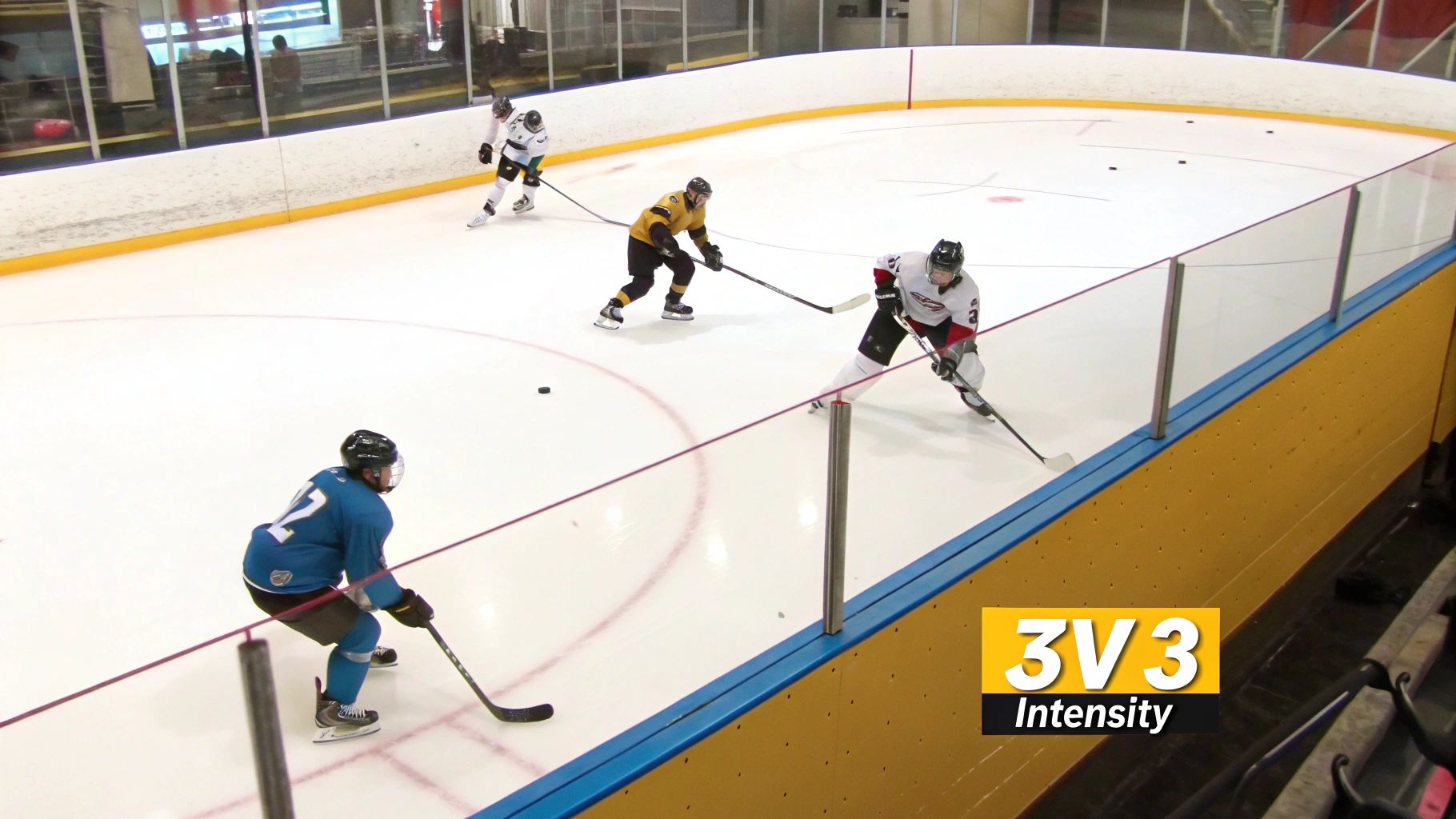
This isn’t just a simple scrimmage; it's a communication accelerator. In these compressed environments, players have less time and space, amplifying the need for constant talk, quick support, and shared problem-solving. Every pass, every defensive switch, and every battle along the boards becomes a micro-test of team cohesion. Players learn their teammates' tendencies under duress, building an instinctual understanding that pays huge dividends during a full-ice, 5v5 game.
How to Implement It
Setting up effective small-area games requires more than just shrinking the rink. It's about designing a drill with a purpose.
- Define the Space: Use bumpers or cones to create a smaller playing surface, typically from the goal line to the blue line or between the face-off dots in one zone.
- Set Clear Objectives: Don't just let them play. Establish rules that drive your team-building goals, such as requiring three consecutive passes before a shot is allowed. This forces puck movement and communication.
- Rotate and Mix Teams: Constantly shuffle the teams between games. This ensures every player on the roster builds chemistry with everyone else, not just their usual linemates. Make it a round-robin tournament for a competitive edge.
Coach's Insight: The Toronto Maple Leafs and Finland's national hockey program are massive proponents of small-area games. They recognize that these drills do more than sharpen skills; they build a collective hockey IQ. When players are forced to read and react to each other in a chaotic environment, they develop a non-verbal shorthand that is impossible to replicate in standard drills.
3. Escape Room Team Challenges
Breaking down a 1-3-1 trap requires communication, quick thinking, and every player understanding their role to solve a complex problem. An escape room takes that same dynamic off the ice. It locks the team in a themed room and challenges them to solve a series of interconnected puzzles to get out before time expires, making it one of the most effective hockey team building activities for developing collaborative problem-solving skills.
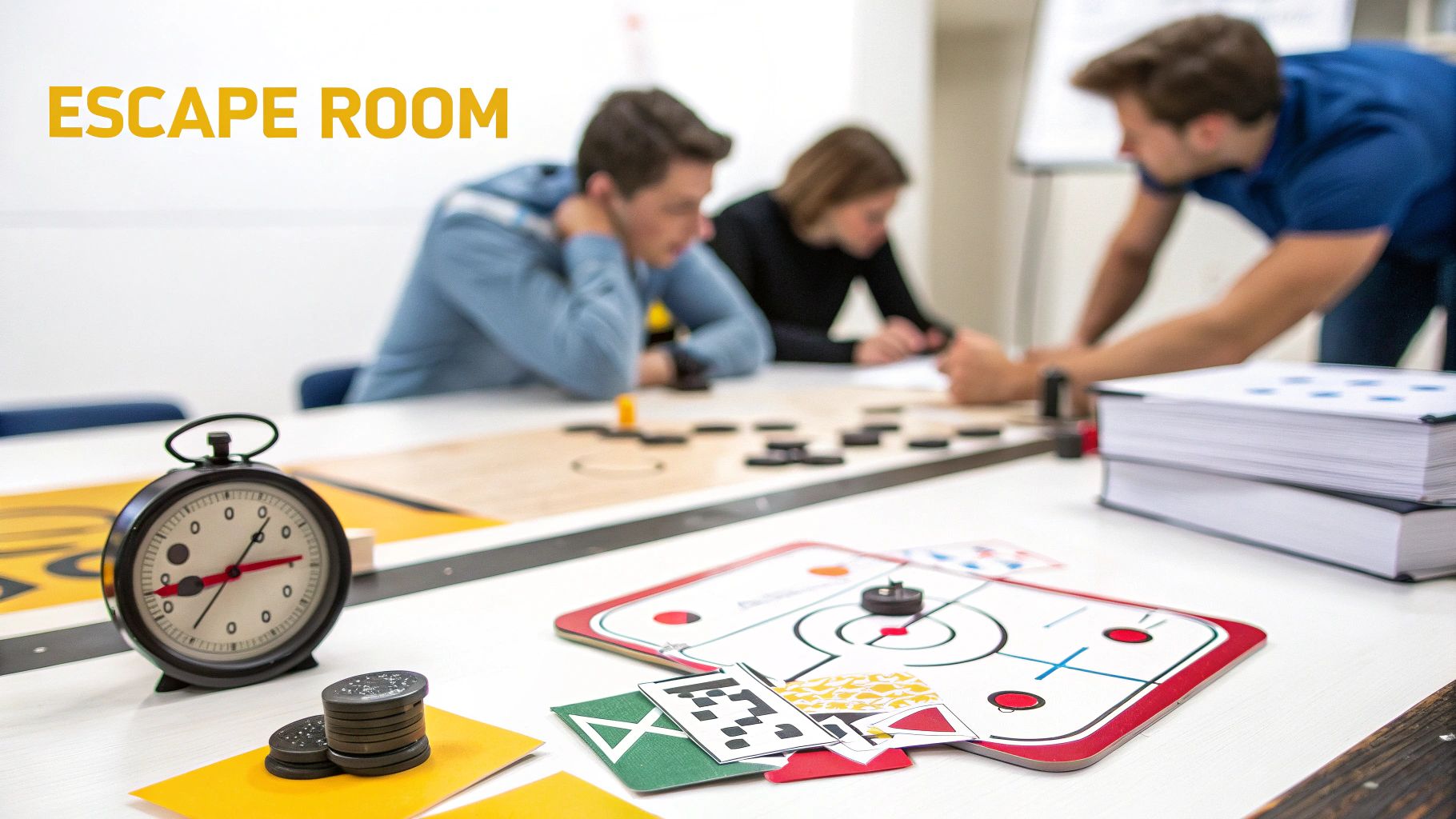
This activity forces players out of their on-ice roles and encourages new leaders and creative thinkers to step up. When the pressure is on, who keeps a level head? Who is the creative mind that spots the hidden clue? This environment reveals team dynamics that might not be apparent during a power play. It’s a fun, high-stakes way to practice communication and poise under pressure, skills that are invaluable in a tight third-period game.
How to Implement It
Success in an escape room is all about preparation and post-activity reflection. Finding the right facility is the first step, with many offering sports or even hockey-specific themes that can make the experience more relevant.
- Choose Wisely: Select an escape room with a difficulty level appropriate for your team’s age and experience. A challenge that is too easy or impossibly hard will diminish the team-building benefits.
- Assign Roles (or Don't): You can pre-assign roles like "clue-keeper," "strategist," or "searcher" to ensure everyone participates. Alternatively, let roles emerge naturally to see who steps into leadership positions organically.
- Debrief the Experience: Afterwards, lead a discussion. Ask questions like, "How did our communication help or hinder us?" or "How did we handle a setback when a puzzle stumped us?" Connect these experiences directly to game-day scenarios.
Coach's Insight: The Colorado Avalanche have famously used escape rooms as a key bonding activity. By putting players in a situation where success depends entirely on teamwork and not athletic ability, they level the playing field. It reinforces that every player, from the star sniper to the rookie defenceman, brings a unique perspective crucial to the team's victory.
4. Charity Community Service Projects
Winning championships is incredible, but building champions in the community leaves a lasting legacy. Taking the team off the ice and into the community for a shared purpose strengthens bonds in a way that no practice drill ever could. Engaging in volunteer work is one of the most powerful hockey team building activities because it shifts the focus from individual performance to collective impact, fostering empathy, perspective, and a powerful shared identity.
This isn't about simply checking a box for community hours. It's about rallying together for a cause bigger than the game itself. When players collaborate to run a youth hockey clinic, sort donations at a food bank, or visit a local hospital, they see different sides of their teammates. They are working together without the pressure of the scoreboard, communicating and problem-solving in a new context. This shared experience builds a deep, authentic camaraderie that translates into a more selfless and supportive locker room.
How to Implement It
The key is to find a project that resonates with the team and allows for genuine connection. Planning is essential to ensure the experience is meaningful and well-organised.
- Empower the Players: Instead of mandating a specific charity, present a few options and let the players vote. This creates immediate buy-in and ensures they are passionate about the cause they're supporting, whether it's an environmental clean-up or a partnership with Special Olympics.
- Make it a Team Effort: Plan the logistics together. Assign small groups to different tasks, like coordinating with the charity, organising transportation, or managing social media posts about the event. This builds leadership and accountability skills.
- Connect it to Team Values: Frame the service project around the team's core principles. If a core value is "hard work," connect it to the effort required at a food bank. If it's "community," highlight how the team is giving back to the fans and neighbours who support them every game.
Coach's Insight: The Winnipeg Jets' "Hockey for All" initiative is a prime example of this in action. By running clinics and providing resources for underserved youth, players connect with their community on a personal level. This reinforces the idea that being a Jet is about more than just what happens on the ice; it's about being a positive force in the city of Winnipeg, strengthening the team's internal bond through a shared external mission.
5. Communication-Based Passing Drills with Eyes Closed or Restricted Vision
Hockey is a game of instinct, but those instincts are built on a foundation of elite communication. On a chaotic power play or a frenzied penalty kill, verbal cues are just as important as a head-man pass. To elevate that essential skill, some of the most effective hockey team building activities involve intentionally removing a player's primary sense: their vision.
These drills, which use blindfolds or restricted-vision goggles, force players to abandon visual reliance and operate purely on trust and verbal direction. When a player can't see the open ice, they must depend entirely on their teammates' calls to know where to move, when to release the puck, and who is available for a pass. This builds an extraordinary level of auditory awareness and reinforces the need for loud, clear, and precise on-ice talk, a skill that pays massive dividends when the puck drops.
How to Implement It
You'll need a safe, controlled area on the ice, plenty of pucks, and a set of blindfolds or practice jerseys that can be pulled over a player's helmet cage. Safety and clear instructions are paramount.
- Establish a Clear Cue System: Before starting, the team must agree on specific verbal commands. Simple calls like "Stick!" (for a pass target), "Left!", "Right!", "Time!", or "Man on!" become the group's lifeline.
- Start Stationary: Begin with a simple circle passing drill. One player in the centre is blindfolded while the players on the perimeter use verbal cues to guide passes to and from the centre player. This focuses on building the communication framework without the complexity of movement.
- Progress to Controlled Movement: Advance to a two-on-zero drill where one player is blindfolded and must rely on their partner's voice to navigate down the ice, stickhandle, and take a shot. The guide provides a running commentary, calling out direction and distance to the net.
Coach's Insight: USA Hockey's National Team Development Program has utilized vision-restricted drills to sharpen sensory skills and communication. They understand that a team that can connect without seeing each other develops a deeper, more intuitive chemistry, allowing them to anticipate plays and support each other instinctively in high-pressure game situations.
6. Team Meal Preparation and Cooking Challenge
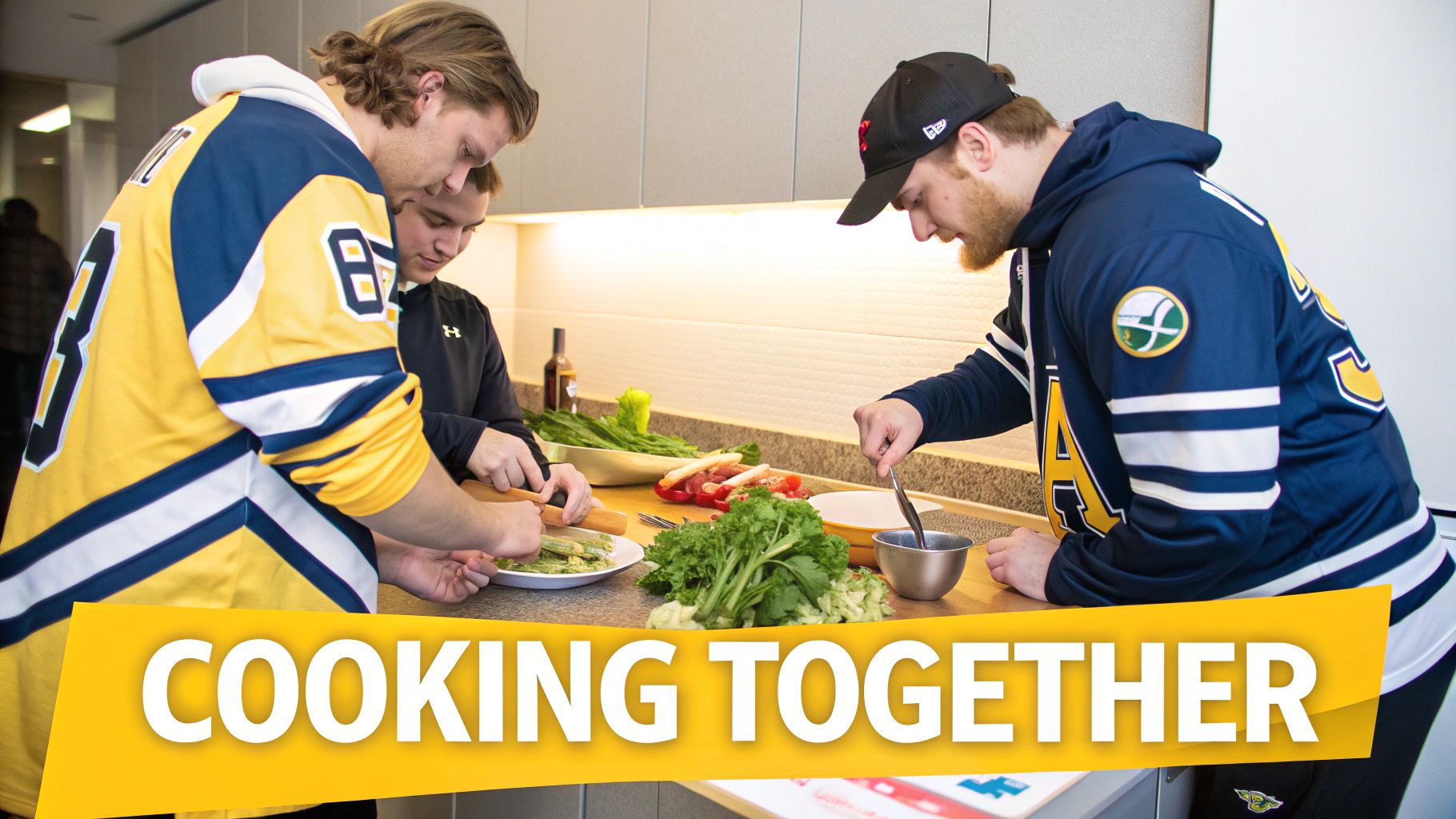
The chemistry that wins championships isn't just built on breakout passes and power plays; it's forged in shared experiences. Taking the team from the rink to the kitchen for a meal prep challenge is one of the most effective and enjoyable hockey team building activities you can organise. It trades sticks and pucks for knives and chopping boards, but the core principles remain the same: communication, role execution, and working together toward a common goal.
This activity transforms the critical, yet often individual, task of athlete nutrition into a collaborative mission. When players have to rely on each other to prep ingredients, manage cooking times, and plate a final dish, they are practicing the same synchronized effort needed to execute a perfect set play. It’s a low-pressure environment to reinforce accountability and celebrate a shared success that isn't measured by a scoreboard.
How to Implement It
A successful cooking challenge requires more planning than a simple scrimmage, but the payoff in team unity is immense. You can use a community kitchen, a team member's home, or a dedicated culinary event space.
- Assign Roles and Recipes: Break the team into small groups of 3-5 players. Provide each group with the same healthy, performance-focused recipe and assign clear roles (Head Chef, Prep Sous-Chef, Plating, Cleanup) to encourage structure and prevent chaos.
- Introduce a Competitive Twist: Turn up the heat by making it a "Top Chef" style competition. Bring in coaches or parents to act as a judging panel, scoring dishes on taste, presentation, and teamwork. This friendly competition adds a layer of excitement and motivation.
- Integrate Nutrition Education: Invite a sports nutritionist to kick off the event with a brief talk on fuelling for performance. This connects the fun activity back to on-ice results and gives players practical knowledge they can use all season. Beyond just cooking, there are many unforgettable team building activities involving food that can strengthen a team's bond.
Coach's Insight: Many OHL and university programs integrate cooking workshops into their rookie orientation. It's a fantastic icebreaker that also equips young players, many of whom are living away from home for the first time, with essential life skills. It reinforces that elite performance requires dedication both on and off the ice.
7. Penalty Kill vs. Power Play Competitive Tournaments
Nothing forges a bond like battling together in the trenches of a high-stakes special teams situation. Creating dedicated, competitive tournaments focused solely on the power play versus the penalty kill is one of the most effective hockey team building activities because it directly simulates the game’s most intense, momentum-swinging moments. This isn't just a drill; it's a playoff-style showdown that demands communication, sacrifice, and perfect execution.
This format fosters an incredible sense of unity within each specialized unit. When a penalty kill unit successfully clears the zone against a talented power play group, they celebrate that small victory together. Conversely, the power play unit learns to read each other's tendencies and celebrate the precision passing that leads to a top-shelf goal. It's a pressure cooker for chemistry, building trust that pays massive dividends when the real game is on the line.
How to Implement It
Transforming a regular practice segment into a high-energy tournament is all about structure and stakes. You'll want to dedicate a significant portion of a practice session to this on-ice battle.
- Create Balanced Units: Divide your players into several power play (PP) and penalty kill (PK) units. Rotate players through different units over time to build chemistry across the entire roster and prevent cliques from forming.
- Establish a Tournament Format: Run a round-robin or bracket-style tournament. Each "game" could be a full two-minute power play. Award points for goals scored (PP) and successful kills (PK). This creates clear winners and losers, raising the competitive stakes.
- Track Everything and Offer Rewards: Keep detailed stats for each unit. Knowing which PP unit has the best conversion rate or which PK unit is nearly perfect adds a layer of professional analysis. Reward the winning units with something meaningful, like first choice of post-practice snacks or bragging rights with a team-made "Special Teams Champions" belt. For deeper insights, you can analyze real-world player stats from the pros to highlight what makes elite units successful.
Coach's Insight: Many OHL and NCAA programs turn these tournaments into a season-long competition. They maintain a leaderboard in the locker room, turning every special teams practice into a chance to climb the ranks. This sustained competition ensures that focus remains high and that players hold each other accountable for every rep, knowing it contributes to a larger goal.
8. Team-Building Through Mentorship Pairing
The culture of a dressing room is its lifeblood. It's the unspoken code that dictates work ethic, accountability, and resilience. A powerful way to intentionally build and transfer this culture is through a formal mentorship program, one of the most impactful hockey team building activities for long-term success. It pairs grizzled veterans with fresh-faced rookies or new acquisitions to create a direct pipeline of institutional knowledge.
This goes far beyond just showing a new player the best route to the rink. It's about a veteran explaining the "why" behind a specific breakout system, offering advice on managing a long road trip, or simply being a trusted confidant during a goal-scoring slump. This structured pairing accelerates a new player's integration, ensuring they feel valued and understood, which in turn fosters a deep sense of loyalty and commitment to the team's shared goals. It turns a collection of individuals into a connected unit.
How to Implement It
A successful mentorship program is built on purpose, not chance. It requires thoughtful planning from the coaching staff to create pairings that genuinely click and provide value for both the mentor and the mentee.
- Be Strategic with Pairings: Don't just pair your top-line centre with the first-round draft pick. Consider matching based on complementary personalities or similar playing styles. A quiet, positional defenceman might be the perfect guide for a high-flying offensive rookie, helping to round out their game.
- Set Clear Expectations: At the start of the season, define what mentorship means for your club. Outline specific responsibilities, such as pre-practice warm-up routines, post-game debriefs, and at least one off-ice activity per month.
- Encourage Two-Way Learning: Remind veterans that this is not a one-way street. A rookie's enthusiasm or a new perspective on a drill can re-energize a seasoned player. The best mentorships are mutually beneficial relationships.
Coach's Insight: The Detroit Red Wings' dynasty was built on a legendary culture of mentorship, famously passed down from Steve Yzerman. This model, championed by coach Scotty Bowman, ensured that the team's high standards were passed from one generation to the next, creating a self-sustaining cycle of excellence and leadership that defined the organization.
9. Adventure and Outdoor Team Retreats
Sometimes, the most significant breakthroughs for a hockey team happen far away from the rink. Taking the team out of their familiar environment and into the great outdoors for a multi-day retreat is one of the most powerful hockey team building activities available. Facing shared challenges like a tough hike, navigating a river, or a rock-climbing wall builds a unique and profound level of trust and communication that can’t be replicated in a practice drill.
This isn’t just a fun trip; it's a strategic investment in team culture. When players have to rely on each other to set up a campsite or navigate a trail, they are practicing problem-solving, leadership, and mutual support in a high-stakes, non-hockey context. Stripping away the sticks and skates reveals the core character of the team, forging bonds through shared accomplishment and creating memories that become the foundation of locker-room folklore for years to come.
How to Implement It
An outdoor retreat requires careful planning to maximise impact and ensure safety. The key is to create an experience that challenges the group without overwhelming individuals, fostering unity over competition.
- Plan Around the Season: Schedule the retreat during the off-season or a pre-season training camp. This allows the team to bond before the pressure of the regular season begins, without disrupting game or practice schedules.
- Create Structured Challenges: Work with professional guides to organise team-based challenges rather than individual races. For example, split the team into groups for an orienteering course or a raft-building challenge. This forces collaboration and strategic thinking.
- Integrate Reflection: Don't let the lessons learned stay on the mountain. Organise nightly campfires or group debrief sessions where players can discuss the challenges, how they worked together, and how those experiences can be applied to the upcoming season.
Coach's Insight: Many collegiate and professional organisations, like the San Jose Sharks with their retreats in the Lake Tahoe region, use outdoor excursions to integrate new players and solidify team identity. The shared adversity of a challenging outdoor activity accelerates relationship-building and reveals natural leaders within the group, providing invaluable insights for the coaching staff.
10. Film Review and Collaborative Game Analysis Sessions
Breakaways and big saves are what make the highlight reels, but games are won and lost in the small details: positioning on the breakout, gap control in the neutral zone, and reading opponent tendencies. Turning your team’s film review from a top-down lecture into a collaborative workshop is one of the most powerful hockey team building activities available. It builds a collective hockey IQ and ensures every player is on the same page strategically.
When players actively participate in breaking down plays, they take ownership of the team's system. It’s no longer just the coach’s strategy; it becomes their strategy. This shared understanding fosters a deep sense of alignment and empowers players to communicate more effectively on the ice. They start seeing the game through a unified lens, anticipating each other’s moves and supporting plays before they even develop.
How to Implement It
Transforming the film room into an interactive space requires a shift in approach. The goal is engagement, not passive viewing.
- Make it Interactive: Ditch the monologue. Use a tablet or smartboard to pause, draw, and highlight plays. Ask open-ended questions like, "What's the best option for our F3 here?" or "What defensive layer broke down on this zone entry?"
- Assign Player-Coaches: Rotate the responsibility of leading a portion of the review. Task a forward with breaking down the opponent's defensive zone coverage or have a defenceman explain the opposition's power-play setup. This builds leadership and forces players to think critically.
- Focus on the Positives: Don't just create a blooper reel of mistakes. Celebrate the small, smart plays that lead to success: a perfectly executed stick-lift, a crisp zone exit pass, or a great backcheck that disrupted a scoring chance. This reinforces good habits and boosts morale.
Coach's Insight: The Vegas Golden Knights have famously integrated advanced analytics into their collaborative team film sessions since their inception. By empowering players to understand and contribute to the game plan, they build a culture of accountability and high-level strategic thinking that translates directly into on-ice success and cohesion. For those who love this analytical side of the game, exploring tools that offer deeper hockey insights on sportsdle.com can be a fun way to sharpen those skills off the ice.
Hockey Team-Building Activities: 10-Point Comparison
| Activity | 🔄 Complexity | ⚡ Resource requirements | 📊 Expected outcomes | 💡 Ideal use cases | ⭐ Key advantages |
|---|---|---|---|---|---|
| Trust Fall and Spotting Drills | Low — simple setup; needs trained spotters | Minimal — pads, coaches/spotters | Builds interpersonal trust; increases comfort with contact | Pre/post practice; new-team integration | Immediate bonding; quick to run |
| 3v3 or 4v4 Small-Area Games | Medium — modify space and rules; monitor chaos | Low–Medium — ice time, cones, coaching staff | Rapid skill development; improved on-ice communication | High-intensity practices; skill sessions | High engagement; many touches per player |
| Escape Room Team Challenges | Medium — booking and customization | Medium — facility fees, booking logistics | Better problem-solving; reveals leadership roles | Off-ice bonding; inclusive for injured or mixed-ability groups | Memorable experience; low physical risk |
| Charity Community Service Projects | High — planning, partner coordination | Medium — logistics, transport, volunteer time | Stronger shared purpose; improved public image | Community outreach; values-driven initiatives | Long-term impact; inclusive for all players |
| Communication-Based Passing Drills (Vision Restricted) | Medium — safety protocols and supervision | Low — blindfolds/patches, spotters, cones | Dramatically improved verbal cues and spatial awareness | Communication-focused practices; pre-game prep | Cost-effective; significant communication gains |
| Team Meal Preparation and Cooking Challenge | Medium — kitchen logistics and planning | Medium — kitchen access, ingredients, dietary management | Enhanced camaraderie; improved nutrition awareness | Team dinners, road trips, nutrition workshops | Relaxed bonding; teaches practical life skills |
| Penalty Kill vs Power Play Tournaments | High — scheduling, officiating, bracket setup | High — dedicated ice time, officials, stats tracking | Direct improvement of special-teams; measurable results | In-season unit development; competitive motivation | Highly relevant to game success; objectively measurable |
| Team-Building Through Mentorship Pairing | Medium — matching and ongoing oversight | Low–Medium — veteran time, coordinator involvement | Stronger culture; faster rookie integration | Season-long development; onboarding new players | Sustainable culture transfer; leadership development |
| Adventure and Outdoor Team Retreats | High — logistics, safety planning, multi-day coordination | Very High — travel, guides, accommodation, equipment | Deep bonding; increased resilience and trust | Off-season or post-season retreats | Transformational bonding; lasting memories |
| Film Review and Collaborative Game Analysis Sessions | Medium — facilitation skills and prep time | Medium — video software, analyst/coaching time | Aligned tactical understanding; improved hockey IQ | Tactical preparation; learning culture reinforcement | High strategic value; measurable learning outcomes |
The Final Horn: Bringing It All Back to the Room
As the final horn sounds on this roundup, the real work is just beginning. We've explored a wide range of hockey team building activities, from the pure adrenaline of small-area games to the focused communication required in a blindfolded passing drill. The core lesson is clear: championship-calibre teams aren't just collections of skilled players; they are deeply connected units built on trust, communication, and shared experiences.
The activities detailed here are more than just a way to break up the monotony of practice. They are strategic tools. A community charity event builds empathy and perspective, reminding players they represent more than just themselves. An escape room challenge translates directly to on-ice problem-solving under pressure. Even a simple team meal fosters the kind of casual camaraderie that can't be replicated during a gruelling bag skate. It’s in these moments, away from the structured drills, that players learn to rely on one another as people, not just as linemates.
Key Takeaways for Your Team
The most successful team-building programs are those that are intentional and varied. Remember these core principles as you implement your own plan:
- Mix It Up: Alternate between high-intensity on-ice challenges and relaxed off-ice activities. This prevents burnout and engages different personality types within the room.
- Purpose is Paramount: Every activity should have a clear objective. Are you working on non-verbal communication? Problem-solving? Building trust? Define the goal beforehand to guide your debriefing session.
- Empower Player Leadership: Allow veteran players to lead certain activities or mentor younger teammates. This builds a stronger leadership core and gives everyone a stake in the team's culture.
- Keep it Fresh: Don't be afraid to try new things. The modern locker room is as much about digital connection as it is about on-ice chemistry. Integrating fun, competitive challenges like NHL trivia can keep the hockey talk and friendly rivalries going on the bus, in the hotel, or during downtime.
Your Next Shift: Putting It All Into Action
The true value of these hockey team building activities is unlocked when they become a consistent part of your team's culture, not just a one-off event. Start small. Pick one or two activities from this list that align with your team's current needs. Is communication breaking down in the defensive zone? Try the restricted-vision passing drills. Does the team feel a bit fragmented? Organise a team cooking challenge.
Building a cohesive unit is an ongoing process, a season-long power play that requires effort from every single player, coach, and staff member. It’s about creating an environment where players are not only willing to block a shot for their goalie but also know how their centreman takes his coffee. That’s the kind of chemistry that wins face-offs, kills penalties, and ultimately, hoists trophies. It’s the invisible force that turns a good team into a great one, ensuring that when the pressure is on and the game is on the line, everyone is pulling the rope in the same direction.
Ready to keep the competitive hockey spirit alive off the ice? Challenge your teammates and test your knowledge with daily NHL trivia games at SportsDle. It's the perfect way to fuel those locker-room debates and see who truly knows the game best. Check it out at SportsDle